Sandboxing Arbitrary Pip Installs in Self-Hosted Agent Workloads
Micro-VMs isolate pip installs from the host kernel and shared infrastructure.
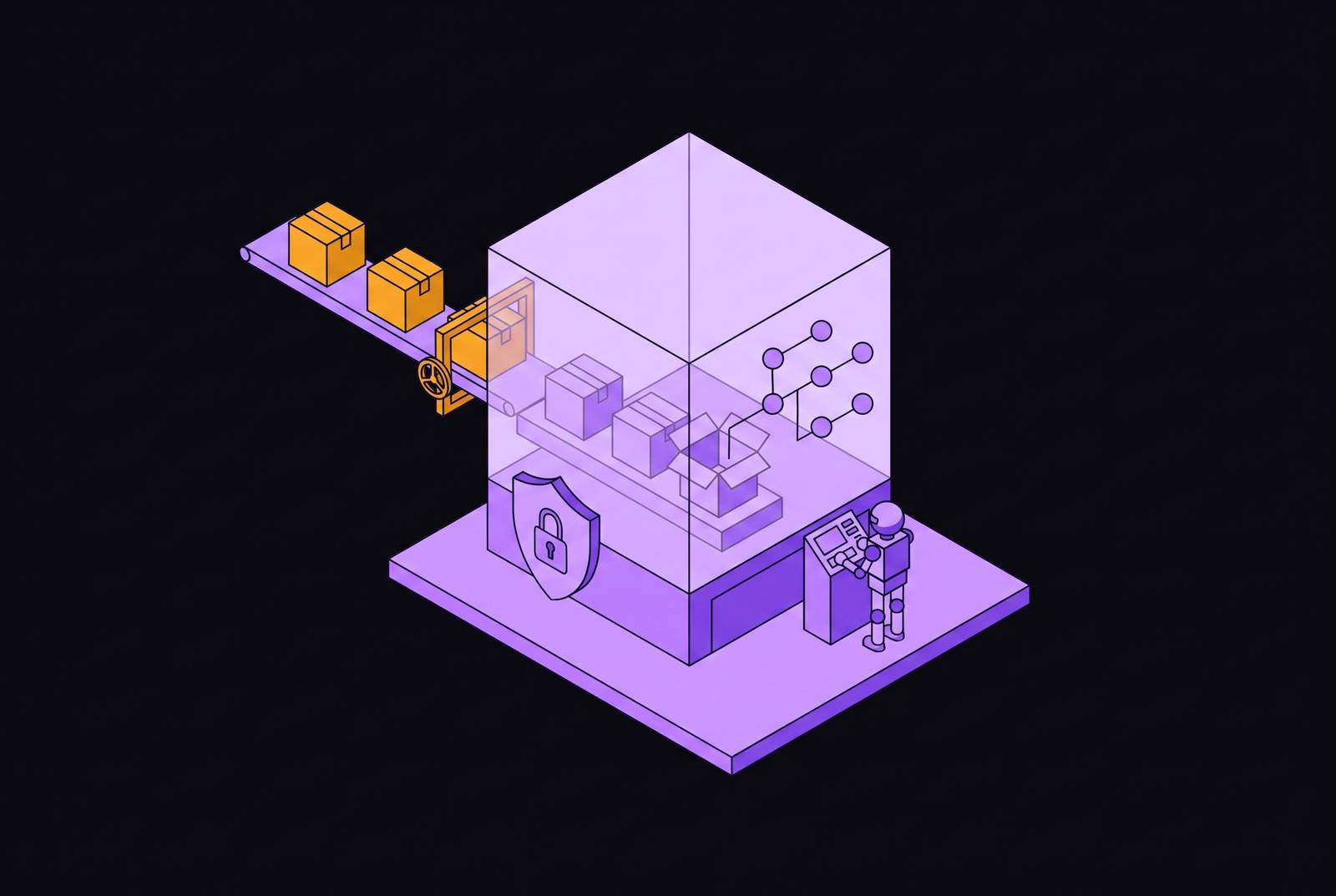
Sandboxing arbitrary pip installs in self-hosted agent workloads requires an infrastructure boundary. Each agent needs its own kernel, restricted network access, and explicitly scoped credentials. For persistent AI agent infrastructure versus serverless functions, the decisive distinction is state ownership, whether execution is a disposable tool call or an agent’s durable home, with packages, working files, and memory restored across sessions.
Why pip install is a different kind of threat inside an agent workload
An agent runs pip install without asking. Before a developer reviews its work, package code can read files, create processes, open network connections, and access credentials available to the process. Every install the agent starts on its own adds code that could become another kernel client on the machine running it.
The threat does not require an obvious malicious release. The postmark-mcp package shipped many clean releases before adding email exfiltration code, illustrating how prior benign behavior can conceal a later supply-chain attack. Escape is not the only failure mode. Install-time code with access to SSH keys, cloud credentials, or private repositories can send them outward without exploiting the kernel, while access to internal networks creates a separate route for pivoting.
What “sandboxed” actually means across the isolation spectrum
Docker/runc containers share the host kernel, using Linux namespaces and cgroups to separate and constrain workloads. That separation does not create a separate kernel. An exploitable path through the shared kernel can therefore expose the host and other containers, even when their filesystem and process views appear distinct.
gVisor inserts a user-space kernel called the Sentry between application syscalls and the host. Sandboxed syscalls do not reach the real kernel directly, providing a stronger boundary than ordinary containers. Compatibility is the trade-off. Because syscall emulation is imperfect, some workloads encounter limits, which must be considered when the agent’s package choices extend beyond a known application stack.
Micro-VMs such as Firecracker, Kata Containers, and libkrun instead give workloads their own kernels behind hardware virtualization through KVM. WebAssembly and V8 Isolates constrain execution within a runtime, without built-in filesystem or network APIs. Runtime isolation fits constrained JavaScript and WebAssembly execution, with arbitrary pip installs that may require filesystem access and subprocesses falling outside its scope. The architectural distinction is whether the workload shares a kernel, reaches an interposed one, or owns a guest kernel.
Why the shared-kernel model fails specifically for pip installs
When an operator deploys a container, the code is often something they have chosen and prepared. Autonomous package installation removes that assumption because install-time Python can exercise the syscall surface exposed by the container. When the agent can also write scripts and manipulate file descriptors, namespace separation leaves the shared kernel as a route beyond the intended workload boundary.
Snyk’s advisory identifies CVE-2024-21626 as a runc container breakout vulnerability that can expose the underlying host OS. In Flowise’s CVE-2025-59528, the failure was different: arbitrary JavaScript could access Node.js modules including child_process and fs.
With credential inheritance, code has a more direct route to credentials than through an escape. An unsandboxed agent receives the API keys, cloud roles, and database connection strings available to its process unless the environment is deliberately narrowed. In high-volume workflows, repeated prompts encourage developers to select “allow all,” removing the interactive check without changing the underlying access.
The micro-VM boundary and why it fits the pip install threat model
A micro-VM places package execution against a guest kernel that the host does not share. KVM supplies the hardware virtualization boundary between that guest and the host environment. Reaching the host requires crossing the virtualization boundary, raising the attack from a namespace escape to a hypervisor escape, which remains possible.
Firecracker uses that boundary with a virtual machine monitor kept small by design. Its design has roughly 125ms cold-start time, approximately 5MB memory overhead per instance, and around 50,000 lines of Rust. The device model is deliberately limited. It includes virtio-net, virtio-blk, virtio-vsock, and serial, with no BIOS, while current versions support ACPI and optional PCI transport through --enable-pci, with MMIO as the default.
Each agent consequently receives its own kernel, filesystem boundary, and package namespace. Package versions that conflict stay separate, and a compromised guest kernel does not by itself give an attacker control over neighboring agents. But the kernel is only one control. The complete design also needs default-deny egress, scoped filesystems, explicitly injected credentials, and a lifecycle that destroys disposable execution state when the task ends. Within that boundary, system package installation, kernel parameter changes, and privileged tooling can operate against the guest rather than requiring elevated access to the shared host.
Network egress filtering as the second half of the pip-install boundary
If a malicious package can read a secret inside the guest and contact an arbitrary destination, host isolation has not prevented exfiltration. The network needs its own enforced boundary. An agent’s ability to write Python does not establish a legitimate need to contact an unknown IP over port 443.
The design principle is default-deny outbound access with an explicit allowlist for the endpoints the task needs. Private subnet blocking must also cover standard private, loopback, and link-local address ranges so that access to the public network does not also give access to internal services. Neither should be inferred from the presence of a micro-VM.
The boundary also needs an immutable audit log. It records every network request, shell command, and file write emitted by the sandbox, making post-incident reconstruction possible. The combined policy defines where execution can reach and preserves the evidence needed to understand what it attempted.
Snapshot-restore and how it makes per-agent VM isolation economically viable
The claim that per-agent VMs cost too much usually assumes that every VM keeps running with all the resources it needs at peak load. Most agents, however, are idle most of the time. Continuous allocation pays for that silence. Snapshot-restore changes the model by retaining storage while the agent sleeps and releasing its compute allocation.
The mechanism starts with a micro-VM booted into a ready state, including a base Python environment and common packages. Its memory and block device state are snapshotted, and later sandboxes restore as copy-on-write forks of that base. Each agent retains its own divergences. Installed packages and working files add to the shared foundation rather than requiring a complete disk allocation for every instance, allowing many isolated agents to share a host economically.
Restore performance depends on the toolchain: Firecracker can achieve sub-second restore with purpose-built snapshot pipelines, whereas a QEMU/libvirt q35 stack restores to a live guest in roughly 3.7 seconds through its fast-resume primitive. That difference affects whether it makes sense for the agent to sleep between requests. Snapshot retention is equally consequential, because expiration introduced to save storage can break an agent’s memory continuity. Teams deploying persistent agents should audit provider expiration windows before relying on snapshots as durable state.
Persistent AI agent infrastructure vs serverless functions—where should state live?
A stateless function-style execution model works well for short tasks such as test runs that can run in parallel and be discarded when done, with state stored outside the execution environment. A long-horizon agent has a different requirement. Its package environment, working files, and the context it has built up must be there across sessions. Destroying those after every task forces repeated installation and startup work, even when the execution itself is securely isolated.
This is the useful distinction when assessing serverless functions such as Lambda or Cloud Run for agent workloads, rather than assuming that every serverless offering has the same capabilities. A sandbox used as a tool backend can remain stateless per call, while a sandbox used as the agent’s home makes the VM its persistent identity. The first model is a poor fit for long-running agents built to keep local state without a separate persistence layer.
Working files, installed packages, browser sessions, and cached credentials can live on a block device snapshotted with the VM and restored on wake. Credential persistence still requires explicit lifecycle rules. Task credentials are provisioned at task start and revoked at completion, the host credential environment never enters the VM, and credential access is audited. In a per-user model, each user’s disk and package state remain attached to that user’s micro-VM identity, with sub-second wake dependent on the snapshot pipeline.
Implementing the boundary—what developers actually need to configure
The implementation choice begins with how much infrastructure the team is prepared to operate. Building directly on Firecracker requires managing host TAP interfaces, IP tables, and routing, in addition to the sandbox fleet. That is substantial operational work. It suits teams that want as much control as possible, but asks too much of a startup that plans to deploy its first agent as a weekend infrastructure project.
An embeddable runtime reduces the orchestration work while preserving self-hosting. microsandbox is an open-source runtime using libkrun for micro-VM isolation, with sub-100ms startup on Apple Silicon or approximately 320ms on bare-metal Linux/KVM. Those timings describe different host environments. They should not be treated as interchangeable expectations when planning a fleet.
With managed services, someone outside the application team runs the fleet. Vercel Sandbox became generally available on January 30, 2026, using Firecracker clusters internally called “Hive,” while Deno Sandbox entered beta in February 2026 with a dedicated Firecracker microVM per sandbox. AWS Bedrock AgentCore became generally available in October 2025 with persistent, session-scoped Firecracker sandboxes. Network isolation still needs explicit attention. AgentCore’s VPC/PrivateLink isolation is optional, and AWS Lambda MicroVMs is a separate managed isolation product from Kiro, the cloud-native, spec-driven agentic IDE.
For teams implementing any of these boundaries, the minimum configuration starts with a non-root user inside the VM and default-deny egress with an explicit API allowlist. Secrets belong in a read-only mount injected at task start. Every task needs a hard timeout. Shell commands, file writes, and network requests must go in an audit log, and task-scoped credentials must be revoked when the task ends.
The integration layer needs the same discipline as execution. MCP connects agents to tools, but CVE-2025-6514 showed that OS command injection was possible in the mcp-remote proxy, and CVE-2025-59536 showed that pre-trust hook code execution was possible in a coding agent. When teams plan to build or rent, they must weigh the work of running the surrounding infrastructure alongside guest startup speed.
What the right sandbox makes possible for agent-native products
Instead of asking a developer to approve every installation, the product can permit autonomous package selection within a defined kernel, filesystem, credential, and network boundary. Approval becomes less central to routine execution.
Persistence then turns that environment into a useful product primitive. Each user can have an isolated agent that retains its package state, sleeps to a snapshot, and resumes work without rebuilding its environment for every request. Parallelism follows from the same separation. Agents can install dependencies that conflict, bind the same ports, and run their own build steps without getting in each other’s way in a shared environment.
Agents can clone repositories, install dependencies, run tests, and iterate on code across sessions without requiring a developer to supervise each transition. The infrastructure makes that continuity possible. A sandbox built as an agent’s durable home gives builders a base for autonomous products that last beyond a disposable demonstration.