Snapshot and Restore for Self-Hosted Agent Frameworks
Consistency groups enable production-grade state management for self-hosted agent frameworks.
Self-hosted agent frameworks like LangGraph, CrewAI, AutoGen, and OpenHands can genuinely run in production, but they share a quiet assumption that breaks once real traffic hits them: the agent's state is wherever it was last left, on whatever disk happened to hold it. Three failure modes appear once that assumption meets real workloads. These three problems look unrelated on the surface: one is a billing concern, one is a durability concern, one is a safety concern. They share a single root cause. The agent process has no durable, restorable version of itself that exists independently of the virtual machine it happens to be running on at that moment.
What agent state consists of, and why it is harder to capture than it looks
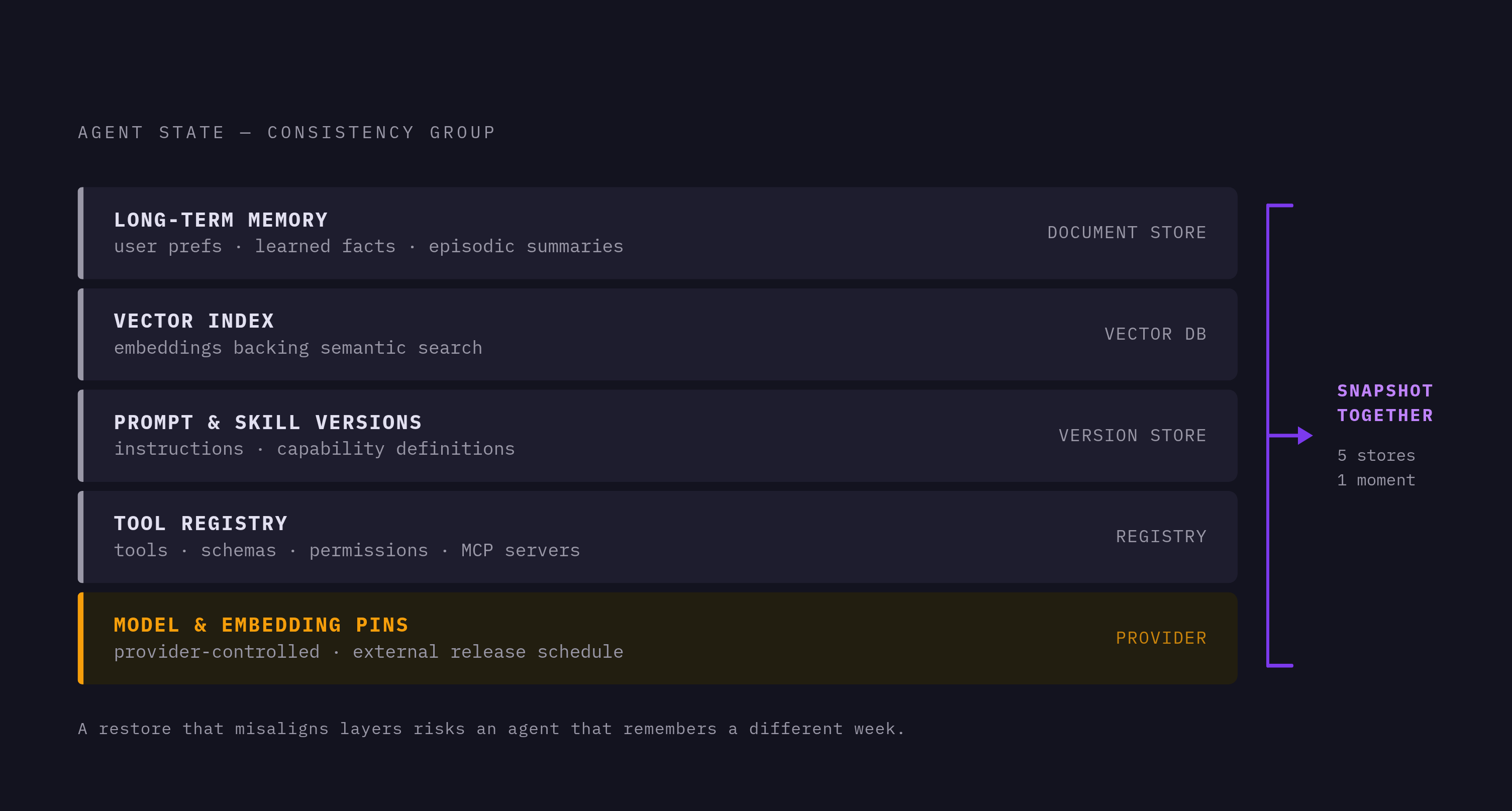
Before anyone can talk sensibly about snapshotting an agent, it helps to be precise about what "agent state" actually is: it is five layers, each with its own storage system and its own update rhythm, not one thing sitting in one database. There's long-term memory: user preferences, learned facts, episodic summaries, usually held in a document store that keeps appending. There's tool configuration: which tools the agent can call, what their schemas look like, what permissions they carry, split across code, environment variables, and an MCP server registry. And there are the model and embedding-model version pins, controlled by a provider or an ML platform on a release schedule nobody on the agent team controls.
Each of these five layers usually has a reasonable durability story on its own. Consider a memory-poisoning incident discovered on a Tuesday. Storage engineering already has a name and a fix for this exact failure shape in databases: the consistency group, the rule that anything which must be restored together must be snapshotted together. Agent infrastructure needs that same discipline applied across its five layers.
The consistency group: defining what must be snapshotted together
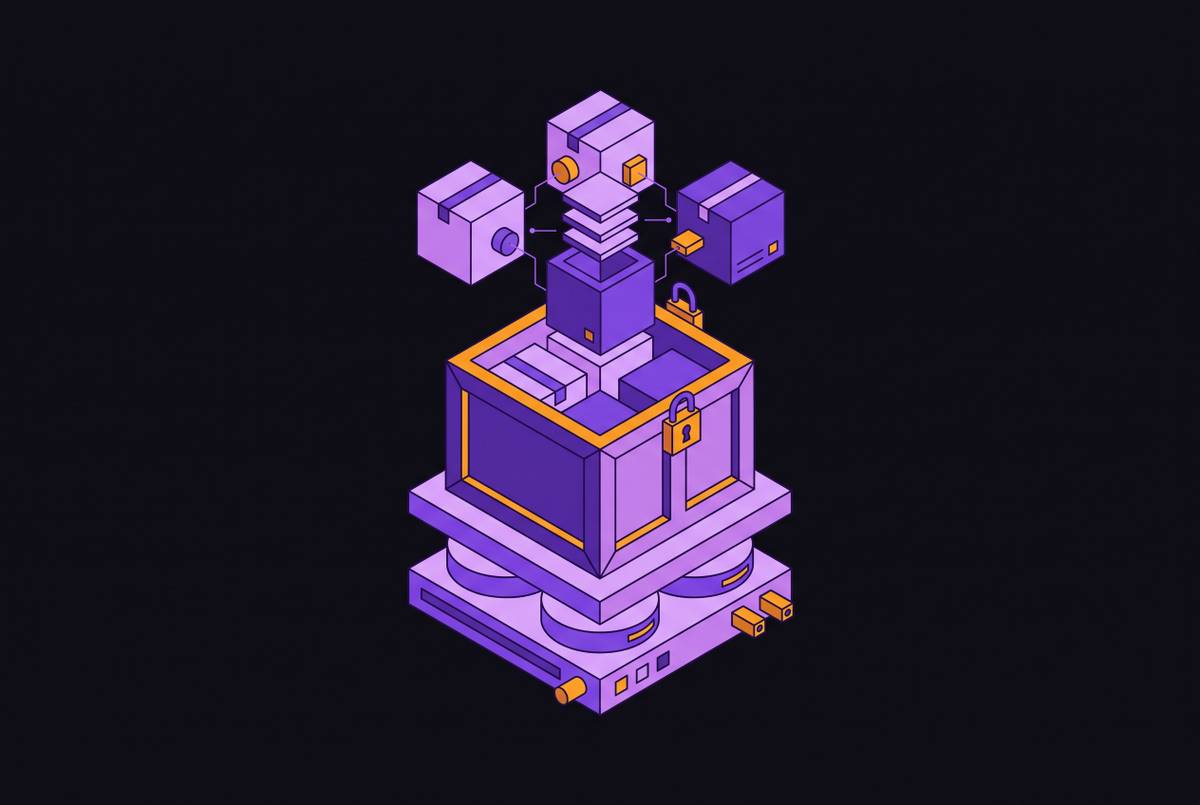
Defining a consistency group for an agent means walking through each of the five stores and asking one question: if this one store changed on its own, would the agent behave differently? If the answer is yes, that store belongs in the group. For a typical self-hosted agent, the working group usually ends up including the memory store, the vector index, the prompt and skill versions, the tool registry, and the model and embedding-model version pins together.
There's a meaningful difference between a crash-consistent snapshot and an application-consistent one. The artifact that ties all of this together is a manifest, a small document listing the exact snapshot IDs, git SHAs, model versions, and embedding-model versions that belong to the same moment. That manifest is what turns a restore into a coherent operation instead of a reassembly of parts that each remember a different week.
One limit deserves to be stated, because overselling snapshot-restore invites the kind of production incident this piece is trying to prevent. A VM snapshot restores whatever state was captured inside that VM. It cannot reach outside the machine, so it cannot reverse an action the agent already took in the world. An email already sent stays sent. If a payment already triggered, it stays triggered, regardless of what the restored memory now believes happened. That limit is the boundary condition that makes a human-in-the-loop gate necessary for anything irreversible: checkpoint before the action, surface it for approval, and only then let the agent proceed.
How Firecracker micro-VMs implement snapshot-restore at the infrastructure level
The consistency group is a design principle. Firecracker is what makes it operationally real. Containers didn't offer strong enough isolation for multi-tenant workloads, and full virtual machines were too slow to boot at the scale AWS needed, so AWS built Firecracker to solve that. A Firecracker micro-VM gives hardware-level isolation with boot times measured in milliseconds.
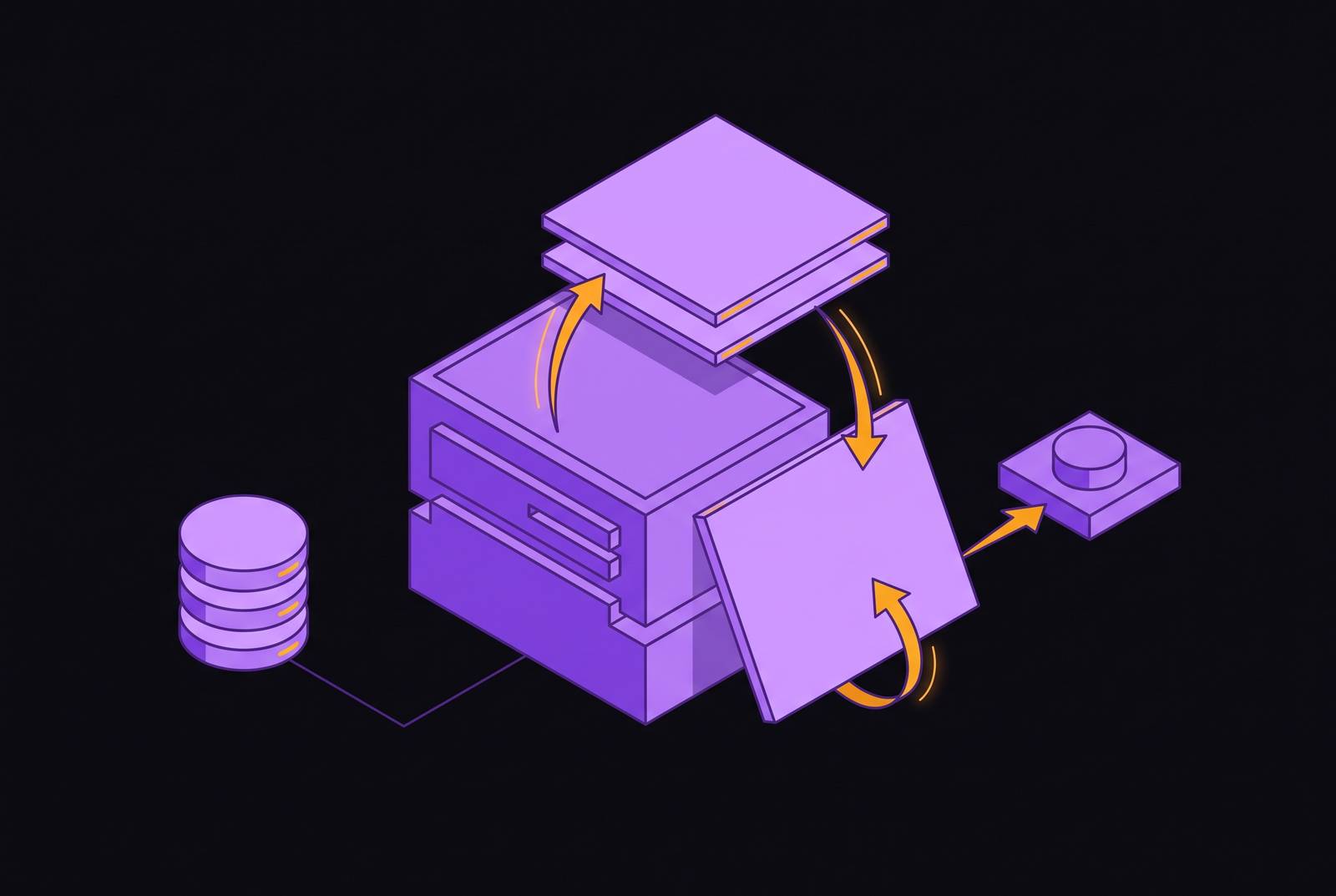
That speed enables what's often called the snapshot-fork pattern. What stays outside that boundary are the side effects the agent already pushed into the world, which is exactly the limit the previous section named. Infrastructure platforms like Maritime pair the agent's application state with VM-level snapshots so that memory, vector index, process state, and kernel are all captured and restored as a single atomic unit, folding idle cost, state loss, and unsafe execution into one mechanism rather than three separate reliability layers an operator would otherwise have to build and maintain. Running each agent in its own isolated micro-VM also means one agent's snapshot can never bleed into or get confused with another's, a multi-tenant guarantee that shared containers don't offer.
How snapshot-restore resolves the idle-cost problem for self-hosted agents
Agent workloads have an unusual rhythm: long stretches of near-total idleness broken up by short, sharp bursts of CPU work. This rhythm makes continuous, flat-rate compute billing a poor match for agents, and snapshot-restore is the mechanism that lets billing follow the work itself. Walk through a single agent turn: a request goes out to a model API and the CPU sits mostly idle waiting on the response; the agent gets an answer back and emits a command, a short burst of CPU work; that command triggers a network call or a package fetch, more partial idling; a build or test runs, another burst; then another model call, and the CPU goes quiet again. Suspending compute during the idle stretches is the condition that makes flat-rate, always-on pricing survivable at all, because without it, every agent pays full price for time spent doing nothing.
Maritime's scheduling model reflects this directly: because most agents are idle most of the time, a snapshot-and-restore scheduler lets an operator pay for storage during the idle stretches while compute stays suspended. Storage isn't free of its own gravity, though. Owning hardware only pays off at a utilization level well above what most idle-heavy agent fleets actually sustain, so the renting-versus-owning decision depends heavily on how idle the fleet really is.
Risk-tiered snapshotting: matching checkpoint depth to action consequence
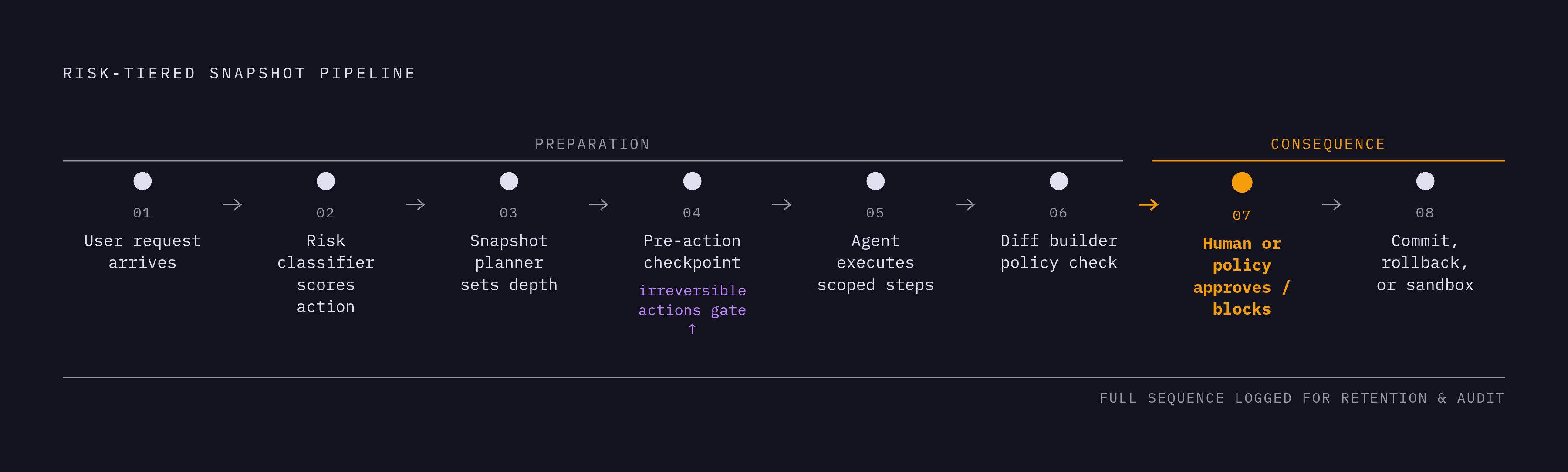
Snapshotting every single agent action at full depth creates its own problem: it piles unnecessary overhead onto read-heavy work while still leaving the genuinely dangerous actions no better protected, since depth alone doesn't substitute for timing. The fix is a tiered approach that matches how much gets captured, and when, to how much damage the action could do. Critical-risk work covers anything irreversible once it leaves the machine, deleting records, charging money, sending a message to someone outside the system, and here the rule is unambiguous: a human has to approve the action before it runs, not review a checkpoint taken after the fact.
That classification has to happen before the agent acts on the plan, because a snapshot taken after the action has already executed is useful only for investigating what happened. A practical pipeline looks like this: a user request comes in, a risk classifier scores the planned action, a snapshot planner decides what to capture, a pre-action checkpoint gets taken, the agent executes its scoped steps, a diff builder and policy check review what changed, a human or an automated policy approves or blocks it, and the result gets committed, rolled back, or continued in a sandbox, with the whole sequence logged for retention and audit. The manifest from the consistency-group design does real work here too, recording at each tier what was captured, when, and at which model and tool version, so a restore becomes a deterministic operation. Snapshot payloads themselves should be encrypted, access-controlled, and handled with deletion in mind, while the metadata, who ran it, what it touched, when, which tenant, what risk tier, what the outcome was, whether a restore succeeded, should live separately from the large payloads and stay indexed so it can actually be searched later.
Applying snapshot-restore to the major self-hosted frameworks
Every major self-hosted framework takes a different stance on state persistence, and the gap between what each one supplies out of the box and what a real production snapshot strategy needs is exactly the work an operator ends up doing themselves. That checkpoint covers in-graph state well, but it doesn't reach the vector index, the prompt registry, or tool configuration, so the operator still has to coordinate those into a consistency group by hand. LangGraph fits best where the orchestration is complex and the stakes are high enough to justify the setup work; it's available in Python and TypeScript and stays model-agnostic throughout.
CrewAI gets a working multi-agent prototype running faster than almost anything else in this space, but its state persistence is coarser than LangGraph's: Flow-level persistence through @persist and SQLite rather than per-node checkpoints, and failure recovery still depends on restart logic you have to write. Moving a CrewAI prototype into production means supplying the checkpointing and restore mechanics almost entirely from scratch. AutoGen's story changed materially in October 2025, when Microsoft moved it into maintenance mode as Agent Framework entered public preview, folding its architecture into the broader Microsoft Agent Framework, which unifies AutoGen and Semantic Kernel and reached general availability on April 3, 2026. The risk-tier framework maps onto OpenHands naturally too: file edits are medium risk, production deployments are high, and any external API call is critical.
Across all five, whether the consistency group can actually be captured atomically depends on the infrastructure layer beneath the framework itself, the VM, the persistent disk, the snapshot scheduler, and frameworks running as a single process inside a micro-VM get VM-level snapshotting automatically while frameworks spread across multiple services need the consistency group coordinated by hand. The consistency group becomes the contract between the framework and whatever infrastructure sits underneath it: when a hosting platform like Maritime receives a consistency-group manifest, it knows exactly which stores need to move together, and can enforce an application-consistent snapshot at the VM boundary, capturing not just bytes on disk but the logical coherence that lets an agent wake up into a state the framework can actually trust. Maritime's per-agent micro-VM model runs each framework instance in its own isolated environment with a persistent disk and a snapshot-restore scheduler, so the VM-level snapshot covers in-process state automatically and narrows the operator's remaining coordination work to whatever lives outside the VM boundary, the vector index, the prompt registry.
Answering the operational objections to snapshot-restore
Skeptical infrastructure teams raise fair objections that deserve a straight answer rather than a dismissal, and none of this comes free. Networking is the one that comes up most often: micro-VM networking doesn't have the mature CNI tooling that containerized workloads enjoy, so TAP interfaces, IP tables, and routing on the host have to be managed by hand. Restore verification is the third: a snapshot nobody has actually tried restoring from is a liability sitting on the books, and production snapshot strategies need periodic restore drills to confirm it actually works.
The limit on reversing external actions doesn't get fixed by a better snapshot. The critical tier of the risk framework fixes it, gating anything irreversible behind human approval before it happens; if a team skips that gate and hopes a snapshot will let them roll back an email that already got sent, they will find the snapshot has nothing to offer them there. The honest answer to most of these objections is that the complexity is manageable, and the alternative, agents with no durable state at all, gets worse the more the fleet grows: idle cost keeps compounding, state-loss incidents keep compounding, and unsafe execution without a prior checkpoint keeps compounding in ways that the overhead of running snapshots does not. Managed infrastructure that handles the networking, storage, scheduling, and restore mechanics shrinks the operator's remaining job down to the two things that actually require application-level judgment: defining the consistency group and setting the risk tiers.
Snapshot-restore as the primitive that makes per-user agent deployment practical
A per-user agent model, where each user gets a persistent agent rather than a shared, stateless one, needs three properties holding at once: the agent has to remember the user across sessions, it has to act inside boundaries that keep one agent's mistake from touching the rest of the fleet, and it has to cost close to nothing while sitting idle, since deploying one agent per user only works economically once that cost approaches zero. If snapshot-restore is dropped out of the picture, at least one of those three collapses. Snapshot-restore is the one mechanism that holds all three properties up simultaneously, which is what separates it from a reliability feature added after an incident.
If you build on self-hosted frameworks, the snapshot strategy is a decision about the product itself, handled by more than whoever owns the infrastructure: what the agent is allowed to remember, what it's allowed to do without asking first, and what it costs to run per user once there are a thousand of them. The problem snapshot-restore solves is fundamentally one of distributed coordination. The five layers of agent state, the memory store, the vector index, the prompt versions, the tool registry, and the model pins, each keep their own records reasonably well on their own, but agent behavior depends on all five together, and without a shared record of how they lined up at a given moment, a restore risks stitching together parts that each remember a different week. LangGraph, CrewAI, OpenHands, and the rest of the frameworks covered here supply the logic an agent runs on. Snapshot-restore at the VM level supplies the durability, the economics, and the execution boundaries that turn that logic into something deployable as a product that survives past a demo. Teams that design snapshot-restore into the architecture from the beginning are the ones positioned to ship agent-native products at the scale a thousand users, or a hundred thousand, actually demands, rather than discovering the need for it only after the first production incident makes the case for them.