Running LangGraph Agents With Isolated Execution Environments
LangGraph agents need isolated execution environments to safely run untrusted code.
LangGraph gives you a graph-based runtime, so your agents can reason in cycles, branch on conditions, and survive restarts, and they never lose their place. Its reach stops at orchestration: it decides what happens next inside the graph, but it has nothing to say about where a tool call actually runs. That gap, between what the framework coordinates and what it cannot protect, is the subject of this piece.
What LangGraph actually manages and what it leaves unresolved
Three primitives make up the model. A StateGraph holds the whole thing together as a container. Nodes are plain Python functions, and they read shared state and mutate it. Edges connect nodes to each other, either unconditionally or based on some test of the current state, which is how a graph can loop back on itself or send execution down one branch instead of another.
State updates in LangGraph are incremental rather than wholesale. When two nodes run at the same time and touch different fields, LangGraph merges their outputs rather than forcing one to overwrite the other. When two nodes write to the same field, a reducer function decides how those competing writes resolve, and add_messages is the standard example. This is what makes parallel node execution coherent instead of a race condition waiting to happen.
Persistence runs through the checkpointer, a pluggable backend, SqliteSaver for development or single-process work, PostgresSaver for production, that snapshots the full graph state after every node and keys that snapshot to a thread_id. A crash halfway through a run, a rolling deploy that kills the process, a human-approval pause that lasts for days: all three resolve to the identical operation. Reload the thread, continue from where it left off. The thread_id is also how LangGraph keeps sessions apart from one another. Each thread carries its own state history, and nothing in one thread can reach into another.
A scheduler-theoretic analysis of LLM agent execution places LangGraph in a class of graph-based executors capable of dispatching multiple nodes at once, enabling what the analysis calls constructive parallelism, where all branches must complete before the graph proceeds. That's a structural departure from the more common single-ready-unit agent loop, where only one step is ever active at a time, and the same analysis finds that 60% of open-source LLM agent projects still build on that single-step loop pattern. Against that backdrop, LangGraph's graph model is the less common design, not the default one.
None of this touches where a tool call actually executes, what kernel it runs under, or whether one tenant's process can read another tenant's memory. LangGraph leaves those questions unanswered, and the deployment layer built underneath it has to answer them instead.
Tool Execution Outside a Controlled Boundary Is a Structural Risk
When you hand an agent a code-execution tool, the real threat surface moves away from the orchestration layer and into whatever process actually runs that tool, and by default that process is the same one holding database credentials, API keys, and customer data. Nothing about LangGraph's design changes once that tool is added. The graph still routes correctly, the checkpointer still snapshots state, and the agent still looks like it is behaving. The exposure sits one layer down, where code the model wrote touches a filesystem.
The ordinary failure case needs no attacker: a model writes a cleanup script, a variable resolves to an empty string instead of a path, and the resulting string becomes the root of whatever filesystem the process is standing on. Nothing adversarial has to happen for that to go wrong. It's a routine mistake that becomes dangerous only because of where it runs.
Prompt injection adds a second, more deliberate version of the same problem. Anything an agent reads from a web page or a user-supplied document functions as an instruction channel straight into the tool loop, so the real attack surface is everything the agent is capable of fetching. A production deployment analysis of LangGraph systems found that most deployment guides skip the sandboxing requirement outright: a code-execution tool gets bolted on because it makes the agent dramatically more capable, and the thirty-odd lines that call subprocess end up living in the same process that holds the Postgres connection string.
Thread-ID isolation doesn't help here, because it was never built for this. It separates sessions at the application layer only, in software, with no kernel-level or hardware-enforced boundary behind it. A compromised process can reach any other tenant's memory that happens to live inside the same host process, because thread scoping was never designed to stop that. Tool execution needs to run somewhere disposable, with its own kernel and no credentials nearby, so you spin it up and tear it down per call. Orchestration and execution are different concerns, and treating them as the same piece of infrastructure is where the risk comes from.
Requirements for a LangGraph Agent's Execution Environment
Safe, production-grade tool execution for a LangGraph agent comes down to five properties, and most deployment targets can't deliver all five at once: kernel-level isolation, persistent disk, sub-second wake latency, idle-cost efficiency, and compatibility with LangGraph's own threading and checkpointing model. These aren't arbitrary preferences. They follow directly from how LangGraph agents actually behave: long-running, frequently interrupted, and serving many users at once.
Kernel-level isolation means escaping the sandbox requires breaking out of both a guest kernel and a hypervisor layer, which is a meaningfully higher barrier than a container escape, where only one boundary stands in the way. If the code is untrusted, or an LLM wrote it without anyone reviewing it line by line, that distinction carries real weight, not just theoretical interest.
If an agent installs packages, writes files, or builds up session-specific state between tool calls, you need a filesystem that can survive the gap between one call and the next. A stateless function that tears itself down after every invocation can't hold onto any of that.
Human-in-the-loop workflows are why wake latency has to stay under a second. A graph can park for minutes or for days waiting on a human approval, then needs to resume the moment that approval lands. But if restoring the environment takes several seconds instead, the interaction model you built around instant resumption no longer holds. Restoring in under a second is a hard requirement for a responsive agent product, not a nice-to-have.
Idle-cost efficiency comes out of the same observation from a different angle. An approval-gated graph spends far more time waiting than running, so a platform that charges for a warm, standing container while a human reviewer sleeps is billing for the wrong thing. The right model charges you for storage while idle, and for compute only while something is actually running.
Compatibility with LangGraph's threading model means the execution environment needs to support the same thread_id-keyed isolation LangGraph already enforces at the application layer. So VM-level isolation applied per thread closes exactly the gap that software-only thread isolation leaves open.
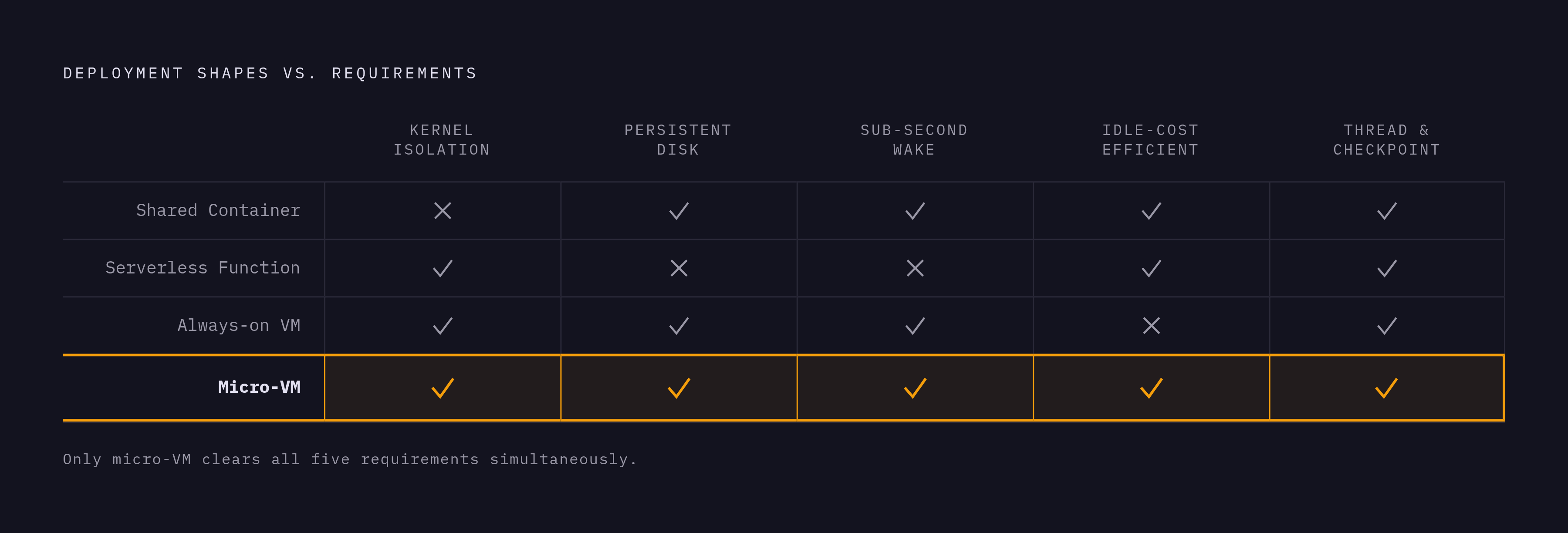
Taken together, these five requirements rule out the deployment shapes you would otherwise reach for first. A shared container fails on isolation. A serverless function fails on both persistence and latency. An always-on VM per tenant fails on idle cost as soon as the fleet scales past a handful of users.
How micro-VM isolation maps onto LangGraph's execution model
Firecracker-based micro-VMs satisfy all five requirements, and not by coincidence. Their design assumptions line up with the operational shape of a persistent, interruptible LangGraph agent almost point for point.
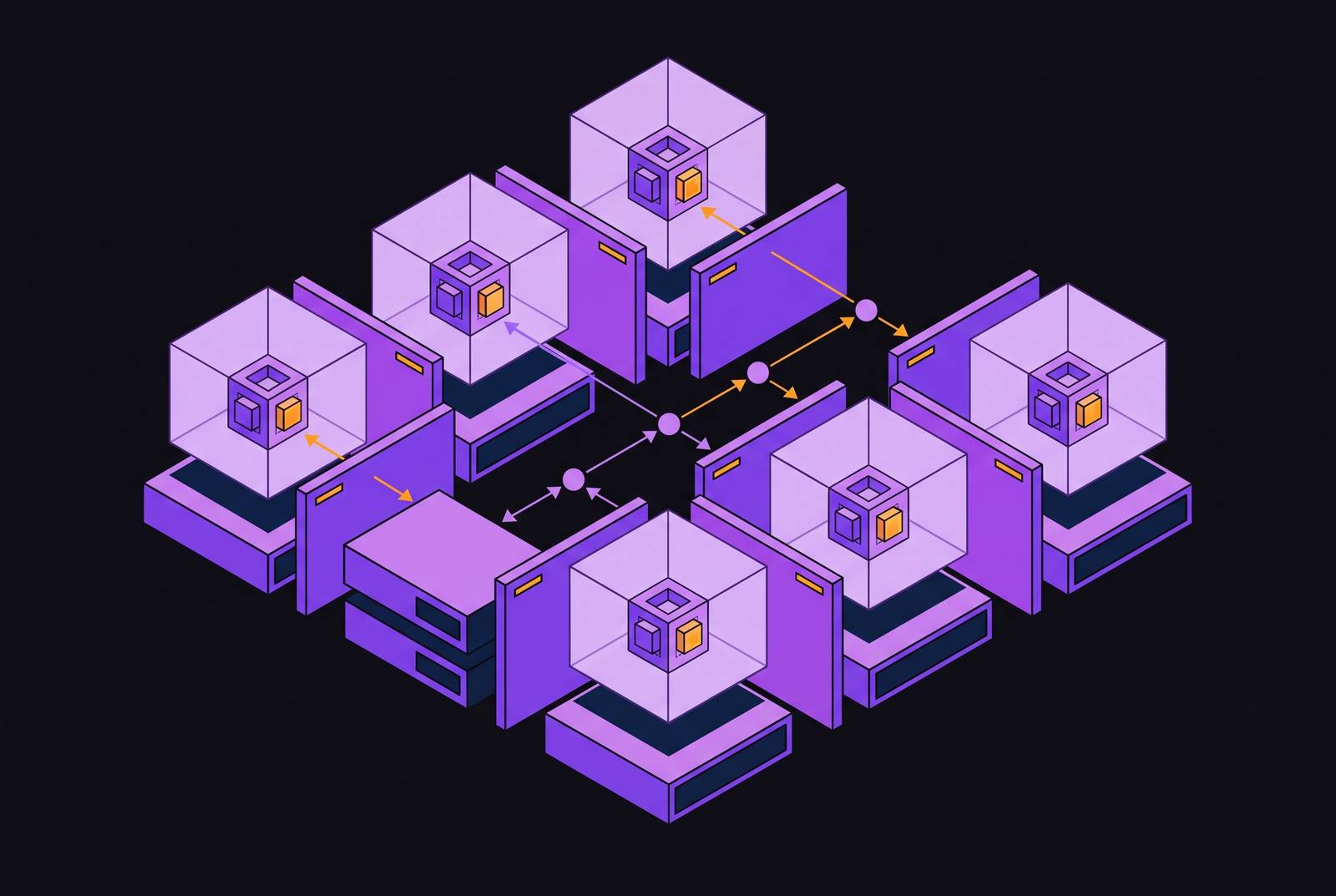
On isolation, each agent or tenant gets its own kernel, so if one tenant's tool execution gets compromised, it has no path into another tenant's memory. That closes the gap that thread-ID isolation alone leaves open at the application layer.
On persistence, a micro-VM carries a real filesystem rather than an ephemeral one. The agent can install packages, write credentials to disk, accumulate browser session state, and find all of it still there on the next tool call, with no re-provisioning required in between.
On latency, snapshot-and-restore brings a suspended micro-VM back to a running state in under a second. The agent resumes mid-execution instead of rebooting from scratch, which is the right primitive for a graph that parks on a human-approval interrupt and then needs to pick up exactly where it stopped.
On cost, the snapshot-and-delete scheduling model turns idle time from a standing per-tenant compute charge into something close to free. There's nothing running to bill for while the VM sits suspended. The agent pays for storage during that stretch, not for the waiting itself.
On threading, one micro-VM per thread_id, or per user, or per session, maps directly onto LangGraph's own isolation model. The VM boundary enforces at the hardware level what LangGraph already enforces at the application level, so the two layers reinforce each other instead of leaving a seam between them.
Two more properties round out the picture, but they don't change the core argument. Hardware virtualization supports GPU passthrough through VFIO device passthrough, which matters for agent workloads that run local model inference or vision tools inside the sandbox, a capability user-space kernel approaches can't offer. And an emerging snapshot-fork primitive, forking a running VM instead of restoring a saved one, suits parallel agent workloads where multiple branches of a LangGraph graph need to spawn independent execution contexts from one shared starting point.
What per-user agent deployment looks like when isolation is built into the infrastructure layer
With each user's agent running inside its own isolated VM, a per-user agent is no longer a scaling problem but a reasonable default architecture. So the security model and the economics stop pulling against each other and start reinforcing the same decision.
At LangGraph's application layer, a single graph already serves many users, each tracked by its own thread_id. Pairing each thread with a dedicated VM pushes that isolation down to the hardware boundary instead of leaving it as an application-logic convention. Each agent's VM holds its own files, its own installed packages, its own browser sessions, and its own credentials, all of it persisting across sessions without ever sharing a process with any other user's agent.
The economics only work because of how snapshot scheduling prices idle time. A flat-rate model that charges for storage while an agent sits idle, rather than for standing compute, makes per-user deployment viable at scale, because most agents spend most of their time doing nothing. That cost structure is what turns one VM per user from an expensive luxury into something a team can default to without flinching.
What sits between LangGraph's thread model and the VM layer is a fleet problem: managing a large number of VMs, routing each incoming request to the right one, waking agents on demand. That routing and scheduling logic is where a snapshot-restore system earns its complexity, making per-user VMs practical rather than just theoretically sound.
Human-in-the-loop workflows show the pattern most clearly. When a graph parks for days waiting on an approval, the agent's VM suspends and starts paying only for storage, the checkpointer holds the full graph state, and when approval finally arrives the VM restores in under a second and the graph picks back up. No compute charge accrues for all that waiting.
Wiring LangGraph's tooling layer, CLI, SDK, and MCP, to an isolated execution backend
LangGraph's first-party tooling was built for deployment flexibility, and the MCP integration layer opens a clean seam where you can attach an isolated execution backend without touching the agent graph itself.
Two first-party developer tools ship with the framework. LangGraph CLI, available as langgraph-cli in Python and as @langchain/langgraph-cli in TypeScript, handles development and deployment. You use the LangGraph SDK, available in both Python and JavaScript, to interact with applications you have already deployed.
MCP, the Model Context Protocol, is now the standard layer for tool connectivity. LangGraph Platform exposes any deployed agent as an MCP tool through a built-in /mcp endpoint. Pulling in external MCP servers as tool sources inside a LangGraph workflow runs through the langchain-mcp-adapters library, installed as langchain[mcp].
The integration pattern itself is straightforward. Servers get defined under a MultiServerMCPClient, using transport: "stdio" for local subprocesses or transport: "http" for remote Streamable HTTP endpoints. A call to await client.get_tools() returns the tool list, and you pass it straight into create_agent(). The direction runs the other way too: Agent Server exposes a LangGraph agent as an MCP tool over Streamable HTTP, callable by any MCP-compliant client at its own /mcp endpoint, which is how a LangGraph agent becomes one node inside a larger multi-agent system.
An isolated execution backend slots into this architecture as just another MCP server. The VM-resident tool executor exposes its capabilities through the MCP interface, and the LangGraph graph reaches it through the same standard adapter layer it would use for any other tool source. The graph doesn't need to know it's talking to a sandboxed VM.
Through all of this, the Postgres-backed checkpointer stays the one authoritative store for graph state, including tool results written back into the message list. The execution environment holds only transient filesystem state alongside it. Both layers persist across interrupts, but they persist different things, and keeping that distinction clear is what makes the integration composable rather than tangled.
Observability Across the Graph-VM Boundary
Moving tool execution into a VM solves the security risk and opens a visibility gap in its place. The execution boundary is also a tracing boundary, and if nobody wires across it deliberately, whatever fails inside the sandbox stays invisible to the graph-level debugger.
LangGraph exposes every node execution as an inspectable event, which makes its graph-level debugging surface precise. A node that calls a sandboxed tool generates a tool-call event in that trace, but something that happens inside the sandbox itself doesn't automatically appear alongside it. The trace stops at the boundary unless something on the other side reports back across it.
Research into in-IDE observability tooling for developers building AI-based features points to a real and growing version of this problem. That research projects that by 2027, 55% of software engineering teams will be building LLM-based features of some kind. As that number grows, so does the distance between where developers actually work, the IDE, the graph-level debugger, and where failures actually originate, inside the tool executor running in its own VM. Closing that distance takes deliberate wiring between the two layers. Without it, the gap between the two becomes one of the more common ways debugging time gets lost on these systems.